
AstroAI L4 vs L7/L7S Tire Inflator: Which Portable Air Compressor Should You Buy?
The AstroAI L4 is the stronger pick for drivers who want longer battery life and faster top-offs. The AstroAI L7/L7S is the better compact-value pick if you want a lighter, lower-cost cordless inflator for routine pressure maintenance.

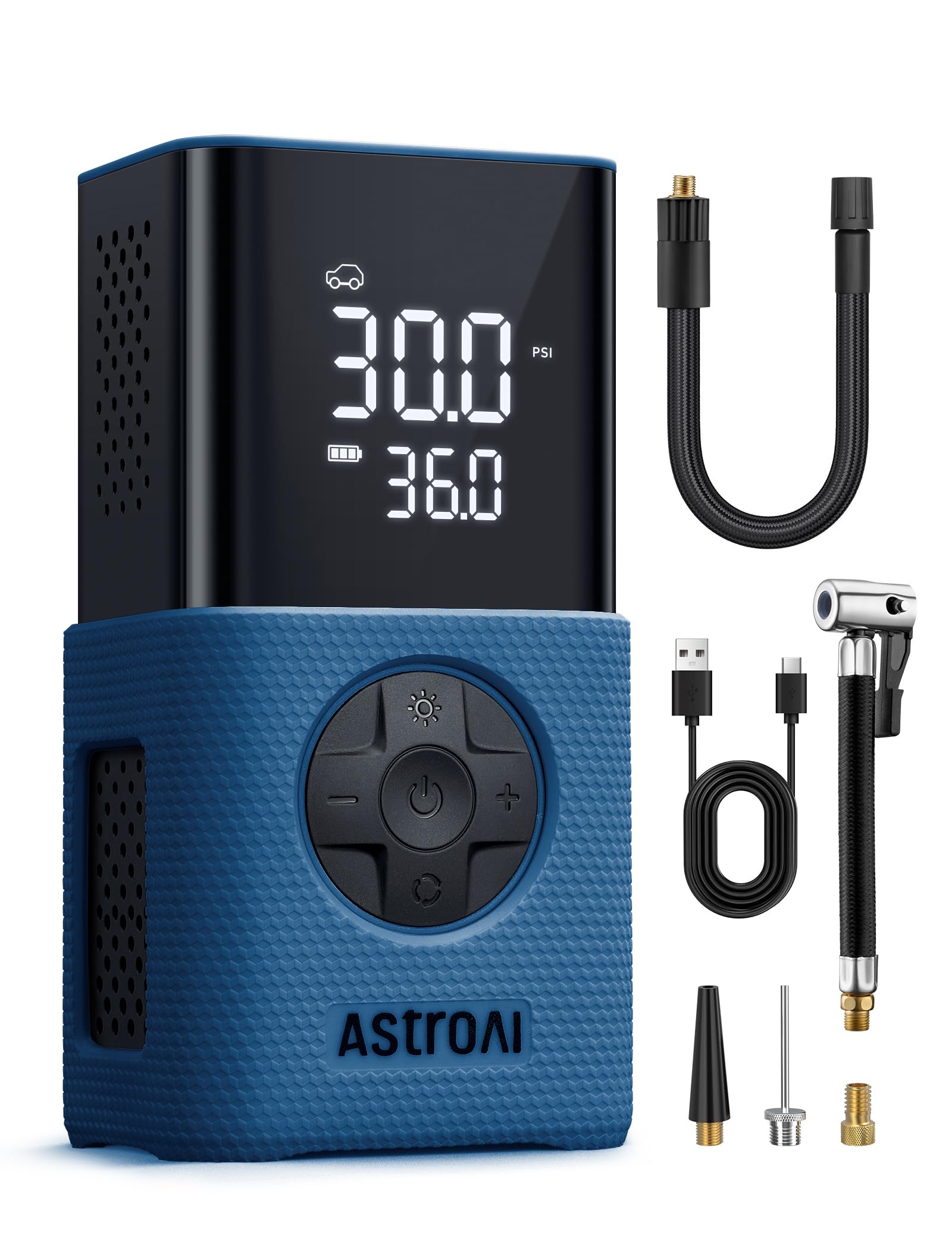
Quick answer: AstroAI L4 vs L7/L7S
Choose the AstroAI L4 if you mainly want a cordless tire inflator for car tire top-offs, emergency preparedness, and fewer recharges between uses. Its stronger listed airflow and larger battery make it the safer all-around pick.
Choose the AstroAI L7/L7S if your priority is a compact inflator for bikes, motorcycles, balls, and regular car tire maintenance. It is lighter and easier to store, but it is not the model I would choose for large or heavy-duty tires.
The AstroAI L4 and AstroAI L7/L7S are both cordless 150 PSI portable tire inflators with preset modes, digital pressure display, auto shut-off, LED light, and emergency power-bank functionality. The real difference is not the maximum PSI. It is battery capacity, airflow, size, connector style, and the type of tire work you expect the pump to handle.
AstroAI L4 vs L7/L7S: side-by-side comparison
| Category | AstroAI L4 | AstroAI L7/L7S | Winner |
|---|---|---|---|
| Best use case Most important buying factor | Car tire top-offs, emergency kit, longer cordless sessions | Compact everyday inflation for car, bike, motorcycle, and balls | L4 |
| Maximum pressure Not the same as speed | 150 PSI | 150 PSI | Tie |
| Battery capacity Listed capacity | 6600mAh | 4000mAh | L4 |
| Airflow Listed air flow capacity | 35 L/min | 17 L/min | L4 |
| Weight & storage Glovebox/backpack use | About 1.1 lb; still compact, but larger than L7/L7S | About 1.01 lb for L7S; very compact and protected by silicone sleeve | L7/L7S |
| Pressure modes Ease of use | Car, motorcycle, bike, ball, and custom mode | Car, motorcycle, bike, ball, and custom mode | Tie |
| Emergency features Roadside utility | LED light modes plus USB output power-bank function | LED light modes plus USB-C/USB input-output power-bank function | Tie |
| Heavy-duty tires Truck/RV/off-road use | Better of the two for demanding top-offs, but still not a full-size compressor | Listing notes incompatibility with heavy-duty tires such as RVs, trucks, and trailers | L4 |
| Amazon social proof Uploaded review/listing data | 4.6 average rating, 762 global ratings in the provided file | 4.4 average rating, 9,812 global ratings in the provided L7S file | Depends |
Pros and cons, head to head
- Larger 6600mAh battery for longer use between charges.
- Higher listed airflow at 35 L/min, useful for car tire top-offs.
- Quick connector makes valve attachment faster.
- Good fit for a car emergency kit, glove box, or garage shelf.
- Usually bulkier than the smallest AstroAI cordless models.
- Not a replacement for a large workshop compressor.
- Customer notes and video summaries suggest large truck tires can still be slow.
- Very compact and easy to store in a car, backpack, or bike bag.
- L7S silicone sleeve improves grip and helps protect against bumps.
- Dual-value display shows current pressure and target pressure clearly.
- Strong value option for routine car, bike, motorcycle, and ball inflation.
- Smaller 4000mAh battery compared with the L4.
- Lower listed airflow than L4.
- Not recommended for heavy-duty tires such as RVs, trucks, and trailers.
Who should buy each AstroAI inflator?
- You want the better cordless inflator for car tire top-offs.
- You care more about battery life and airflow than the smallest possible size.
- You want a stronger emergency inflator to keep in your vehicle.
- You regularly adjust tire pressure on cars, motorcycles, bikes, and balls.
- You want a smaller and lighter portable tire inflator.
- You mostly maintain pressure instead of filling very low tires.
- You like the L7S silicone protective sleeve and compact body.
- You want a practical car accessory gift or a backup inflator for occasional use.
Real-world notes from reviews and videos
What buyers like about the L4
Recent buyer comments repeatedly point to ease of use, compact storage, preset pressure control, and the convenience of keeping it charged in the car. Several reviewers also mention that it works well for topping off car tires and bicycle tires.
What buyers like about the L7/L7S
The L7/L7S earns attention for being small, easy to use, and convenient for regular tire maintenance. Review summaries also highlight the bright display, preset modes, and emergency light/power-bank function.
Where the L4 has the edge
The L4 has the stronger paper specs for car-focused use: larger battery capacity and higher listed airflow. That matters when you need to top off multiple tires, not just inflate a ball or bicycle tire.
Where the L7/L7S has the edge
The L7/L7S is easier to carry and store. For users who only need occasional pressure maintenance, that smaller size may matter more than maximum runtime.
Video evidence and demos
The following videos are useful for understanding inflation behavior, display layout, valve connection, and emergency features. Treat YouTube demos as practical examples, not controlled lab tests.
AstroAI L4 demo
Useful for seeing the L4 battery, preset modes, emergency light, and tire inflation examples.
AstroAI L7 demo
Useful for seeing the L7/L7S-style display, compact size, preset pressure modes, and everyday inflation workflow.
Which model is better for car tires?
For car tires, the AstroAI L4 is the better choice. Both models support 150 PSI, but the L4 has the more useful combination for vehicle top-offs: a larger 6600mAh battery and higher listed airflow. If your tire is only a few PSI low, either model can be useful. If you want a more confidence-inspiring emergency tool, choose the L4.
Which model is better for bikes, balls, and light use?
For bicycles, motorcycles, balls, and light maintenance, the AstroAI L7/L7S makes more sense. It is compact, lightweight, easy to carry, and still includes the key features most users need: preset pressure, auto shut-off, multiple units, and emergency lighting.
Final verdict: AstroAI L4 is the better all-around pick
The AstroAI L4 is the better all-around portable tire inflator because it gives you more battery capacity and stronger listed airflow while keeping the same 150 PSI maximum pressure and smart preset features. It is the model I would choose for a car emergency kit.
The AstroAI L7/L7S is still a smart buy if you want the smaller and more affordable-feeling option for everyday maintenance. It is especially attractive for bike riders, occasional users, and buyers who want the easiest inflator to store.
Choose AstroAI L4 if you want the stronger car-focused inflator.
Better battery capacity, higher listed airflow, and stronger fit for emergency tire top-offs.
Choose AstroAI L7/L7S if you want the smaller everyday inflator.
Compact body, easy storage, silicone protection on L7S, and practical preset inflation.
Internal links to strengthen the AstroAI cluster
Frequently asked questions
Is the AstroAI L4 better than the L7/L7S?
Yes, for most car owners, the AstroAI L4 is the better all-around choice because it has a larger battery and higher listed airflow. The L7/L7S is better if you mainly want a smaller everyday inflator.
Do both models support 150 PSI?
Yes. Both the AstroAI L4 and the L7/L7S list a maximum pressure of 150 PSI. However, maximum PSI does not automatically mean faster inflation. Airflow and battery capacity matter too.
Can the AstroAI L7/L7S inflate truck tires?
The L7S listing notes that it is not compatible with heavy-duty tires such as off-road vehicle, RV, truck, and trailer tires. For larger tires, use a higher-capacity inflator or compressor.
Which is better for bicycle tires?
The AstroAI L7/L7S is usually the more convenient choice for bicycle tires because it is lighter and easier to carry. The L4 also works for bike tires, but its advantage is stronger car-focused performance.
Do these inflators stop automatically?
Yes. Both models include preset pressure and auto shut-off, so the pump stops when the selected pressure is reached.
Should I buy based only on PSI?
No. PSI is only one number. For real-world use, compare battery capacity, airflow, connector type, hose design, size, and whether the inflator is recommended for your tire type.