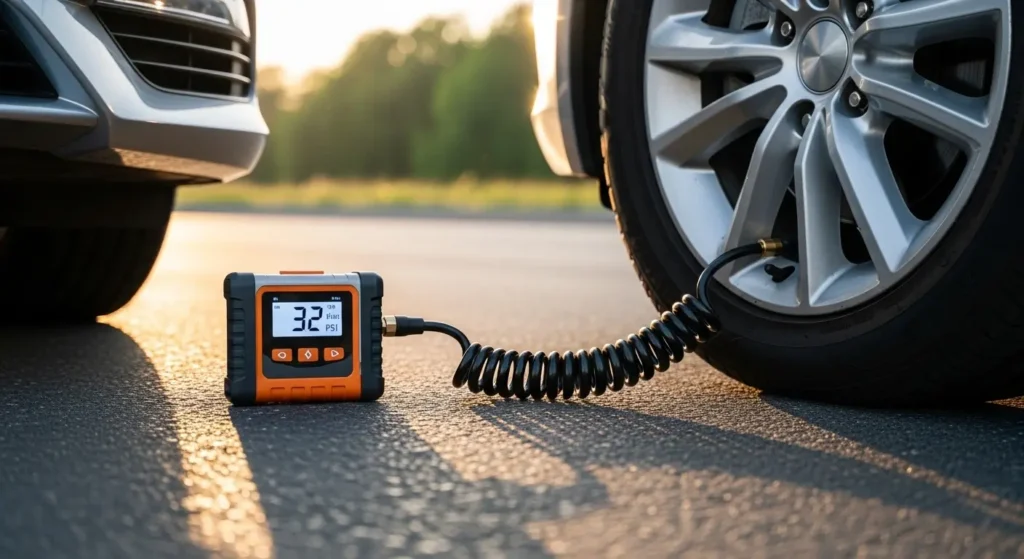
Short Answer: If you don’t already own a quality tyre pressure gauge, yes — an air chuck with a built-in gauge is absolutely worth it. It combines inflation and pressure reading into one tool, eliminates the need to switch between accessories, and costs $22–$37 for a reliable digital model. If you already have an accurate standalone gauge, a bare chuck works fine and costs less.
You’ve connected the hose. The tyre is inflating. But how do you know when to stop? If your answer involves disconnecting the chuck, fumbling for a separate gauge, pressing it onto the valve, reading the pressure, then reconnecting the chuck for another burst — there’s a better way.
An air chuck with a built-in pressure gauge solves exactly this problem. You inflate and read pressure simultaneously, from a single tool. No switching. No guessing. No over-inflating and then bleeding air out.
But are they worth the extra cost over a bare chuck? And if you go with a gauge, should it be digital or analogue? This guide walks through the decision with real product data.
What Is an Air Chuck with a Gauge?
How the Gauge Integrates into the Chuck Body
An air chuck with a gauge — also sold as a tire inflator gauge or inflator chuck combo — is a single unit that incorporates three things: a locking air chuck at the valve end, a pressure gauge (analogue dial or digital display) in the middle body, and an NPT or quick-connect fitting at the hose end. When you press the trigger or open the valve, air flows into the tyre while the gauge reads the live pressure simultaneously.
Most quality models also include a bleed valve — a button or lever that releases a small amount of air from the tyre, letting you reduce pressure without disconnecting. This is essential for precise inflation: inflate past your target by a few PSI, then bleed down to the exact number.
Analogue vs. Digital Gauge Options
Integrated gauges come in two types. Analogue models use a traditional needle-and-dial readout — no battery required, generally more durable, but harder to read precisely, especially in dim light or at awkward angles. Digital models use an LCD display, typically showing 0.1 PSI resolution with auto-backlight. They require batteries but offer clearly superior readability and accuracy for most users.
Integrated Gauge vs. Standalone Gauge: Pros & Cons
This is the core question. Here’s an honest comparison of both approaches.
- ✅ One tool for inflate, deflate, check pressure
- ✅ Read live PSI while air is flowing
- ✅ No switching between tools mid-tyre
- ✅ Built-in bleed valve for precision
- ✅ Compact — one item to store and carry
- ⚠️ Costs $22–$37 for a quality digital model
- ⚠️ Digital versions need batteries
- ✅ Standalone gauges can be more accurate
- ✅ No battery dependency on the chuck
- ✅ Lower upfront cost for the chuck itself
- ❌ Must disconnect to check pressure
- ❌ Two items to manage and store
- ❌ Air escapes every time you disconnect to check
- ❌ Easy to over-inflate and lose time bleeding down
Convenience: The Real Advantage of Integration
The biggest practical gain isn’t accuracy — it’s workflow. With an integrated gauge, inflating a tyre to exactly 35 PSI takes one continuous action: attach the chuck, press the trigger, watch the gauge, release at target. With a separate setup, you inflate in bursts, disconnect to check, reconnect to add more, disconnect again. For four tyres, the separate setup adds 3–5 minutes of fumbling and several micro-bursts of wasted air per tyre.
Accuracy Trade-offs
The best digital integrated gauges (AstroAI, AZUNO, Rhino USA) achieve ±1% accuracy — roughly ±0.35 PSI at 35 PSI. That is more than sufficient for tyre inflation, where your target window is typically ±2 PSI. A premium standalone gauge like a Longacre or Accugage can achieve ±0.5% for racing or professional applications, but the difference is irrelevant for road vehicles.
Cost Comparison
A quality bare locking chuck costs $7–$15. A quality standalone digital tyre gauge costs $18–$30. Combined: $25–$45, two items to manage. A quality integrated digital inflator-chuck costs $22–$37. The integrated solution is often cheaper than the two-item equivalent, while also being more convenient.
| Factor | Integrated Gauge Chuck | Bare Chuck + Separate Gauge | Winner |
|---|---|---|---|
| Workflow speed | One tool, continuous | Disconnect to check each time | Integrated ✓ |
| Accuracy | ±1% (digital) / ±3% (analogue) | ±0.5–1% (quality standalone) | Tie / Standalone ≈ |
| Total cost | $22–$37 | $25–$45 (chuck + gauge) | Integrated ✓ |
| Portability | One item | Two items | Integrated ✓ |
| Battery needed? | Yes (digital) / No (analogue) | Sometimes | Depends ≈ |
| Low-light readability | Excellent (digital backlight) | Varies by gauge | Integrated ✓ |
Digital Air Chuck vs. Analogue Air Chuck with Gauge
Readability and Precision Differences
A digital air chuck displays a precise number — “34.7 PSI” — on an LCD screen. There is no ambiguity about whether the needle is sitting on 34 or 35. Most digital models also switch between PSI, BAR, kPa, and kg/cm² at the press of a button, making them useful internationally or for vehicles with metric specifications.
An analogue gauge uses a needle on a printed dial. Reading it requires good eyesight, proper viewing angle, and decent lighting. At 35 PSI on a 0–60 PSI dial, each minor graduation typically represents 2 PSI — meaning you’re estimating between marks. For casual home use this is acceptable; for precision work or low-light environments, it falls short.
Price Ranges
Entry-level analogue inflator-chuck combos start around $15–$20. Reliable digital models start at $22 (AstroAI) and go up to $37 (Rhino USA) for premium stainless braided hose construction. For most home users, the $22–$25 digital range hits the sweet spot of accuracy, features, and value.
Which Is Better for Home Garage Use?
Digital, without question, for three reasons. First, the backlit LCD makes reading easy even in a poorly lit garage or at night. Second, the 0.1 PSI resolution means you can inflate to exactly 35.0 PSI rather than “somewhere around 35.” Third, the auto-off feature on most digital models extends battery life to months or years — not a practical inconvenience. The only scenario where analogue wins is if you categorically refuse to deal with batteries, or you work in an environment where a digital display could be damaged by water or impact.
| Feature | Digital Air Chuck with Gauge | Analogue Air Chuck with Gauge |
|---|---|---|
| Accuracy | ±1% (0.1 PSI resolution) | ±3–5% (2 PSI per graduation) |
| Low-light use | Auto-backlit LCD | Difficult without torch |
| Unit switching | PSI / BAR / kPa / kg/cm² | PSI only (usually) |
| Battery required | Yes (AAA, lasts months) | No |
| Durability | Good with stainless/brass body | Excellent (no electronics) |
| Price range | $22–$45 | $15–$30 |
| Best for | Home garage, precision, low-light | Rugged environments, battery-free |
Who Should Buy an Air Chuck with a Gauge?
If you inflate tyres a few times a month and want a simple, single-tool setup, an integrated digital inflator-chuck is the obvious choice. No extra gauge to store, lose, or buy batteries for separately.
Higher PSI tyres mean more time inflating — and more risk of over-inflating. A gauge showing live PSI as you inflate is particularly valuable when the target is 80–120 PSI and a 10 PSI overshoot wastes significant time bleeding back down.
Shops with dedicated tyre equipment and calibrated floor gauges may prefer standalone chucks for speed. But for a mobile kit or secondary bay, an integrated digital gauge is still a practical tool.
If you already have an accurate Longacre, Intercomp, or similar precision gauge, a bare locking chuck (like the Milton S-690 or LDCRE 2-pack) is all you need. Don’t pay twice for a function you already have.
Top Picks: Best Air Chucks with Gauge
🏆 Best Digital Air Chuck with Gauge: AstroAI 3–250 PSI Digital Inflator

The AstroAI is the #3 product in all of Automotive on Amazon — a ranking backed by genuine utility. For an integrated chuck-gauge combo, it hits every key spec: ±1% accuracy across a 3–250 PSI range, 0.1 PSI display resolution, LED backlit screen that auto-activates on pressurisation, and a built-in bleed valve for deflation. It connects to both 1/4″ and 1/2″ NPT compressor outputs, making it compatible with virtually every home and shop compressor.
The locking chuck provides hands-free inflation, the trigger controls airflow, and the display shows live pressure throughout. Reviewers particularly highlight how much simpler tyre maintenance becomes — several mention buying a second unit for a spouse or parent after using their own. At $23.99 with a 3-year warranty, it’s hard to argue against it as a first or replacement gauge-chuck.
✅ Pros
- ±1% accuracy — matches dedicated gauges
- 0.1 PSI resolution for precision inflation
- 3–250 PSI range covers all vehicle types
- Auto backlight + auto power off
- Compatible with 1/4″ and 1/2″ NPT
- 3-year warranty — exceptional for this price
- 34,000+ reviews — most validated in category
❌ Cons
- Requires 2× AAA batteries (included in box)
- Some users report valve seal softens with heavy use
- No carrying case
🔵 Best Value Digital: AZUNO Digital Tire Inflator with Pressure Gauge, 200 PSI

The AZUNO is a strong alternative to the AstroAI — same ±1% accuracy and 0.1 PSI resolution, similarly priced, and with 11,600+ reviews averaging 4.5 stars. What distinguishes the AZUNO is its model range: the base model (TIG200D) ships with a standard car/truck chuck, but other variants add a 90° motorcycle chuck, a Presta bike chuck, ball and inflatable nozzles, or a moulded carrying case. If you need to inflate a mixed fleet — car, motorcycle, and bicycle — the AZUNO TIG200B with extra chuck set covers all bases in one purchase.
Reviewers praise its single-hand operation: press the trigger to inflate, press the air bleeder to deflate, and the screen updates live. The wide LCD with large digit display is noted by multiple reviewers as exceptionally easy to read compared to competitors. One long-term reviewer confirmed it remained accurate after 6 months of repeated use across multiple vehicle types.
✅ Pros
- Multiple model variants for different chuck types
- Wide backlit LCD — very easy to read
- Single-hand inflate/deflate operation
- 11,600+ reviews — well-validated
- Available with Presta chuck for cyclists
- Dustproof carry bag included
❌ Cons
- 10 PSI minimum range — not for very low-pressure applications
- 200 PSI max (vs. AstroAI’s 250 PSI)
- One early reviewer reported screen failure after extended use
💎 Best Premium: Rhino USA Digital Tire Pressure Gauge with Inflator, 0–200 PSI

The Rhino USA is the premium tier choice — designed for truck and RV owners who want professional-grade construction without the professional-grade price. The stainless braided hose resists kinking and abrasion in ways that standard rubber hoses can’t. The solid brass chuck hardware and interchangeable chuck system let you swap between vehicle types. The lifetime replacement warranty from a family-owned American company is genuinely unusual in this category.
Its 4.2-star average across 7,600 reviews is slightly lower than the AstroAI — reflecting a minority of reports about the backlight turning off between tyres (by design, to save battery — confirmed by Rhino’s support) and connector compatibility with some non-standard quick-connect systems. For users who know what they’re getting, it’s the most well-built inflator-gauge combo in this roundup.
✅ Pros
- Stainless braided hose — most durable in roundup
- Solid brass chuck + interchangeable chuck system
- Lifetime replacement warranty
- Large easy-to-read display + glow-in-dark dial
- Built-in deflator valve
- American-owned brand with real customer support
❌ Cons
- Most expensive in this roundup ($36.90)
- Backlight turns off between tyres by design — some find this annoying
- Lower overall rating than AstroAI (4.2 vs 4.5)
Frequently Asked Questions
Disclosure: This post contains affiliate links. If you purchase through our links, we may earn a small commission at no extra cost to you. All product recommendations are based on independent research and verified review data.